
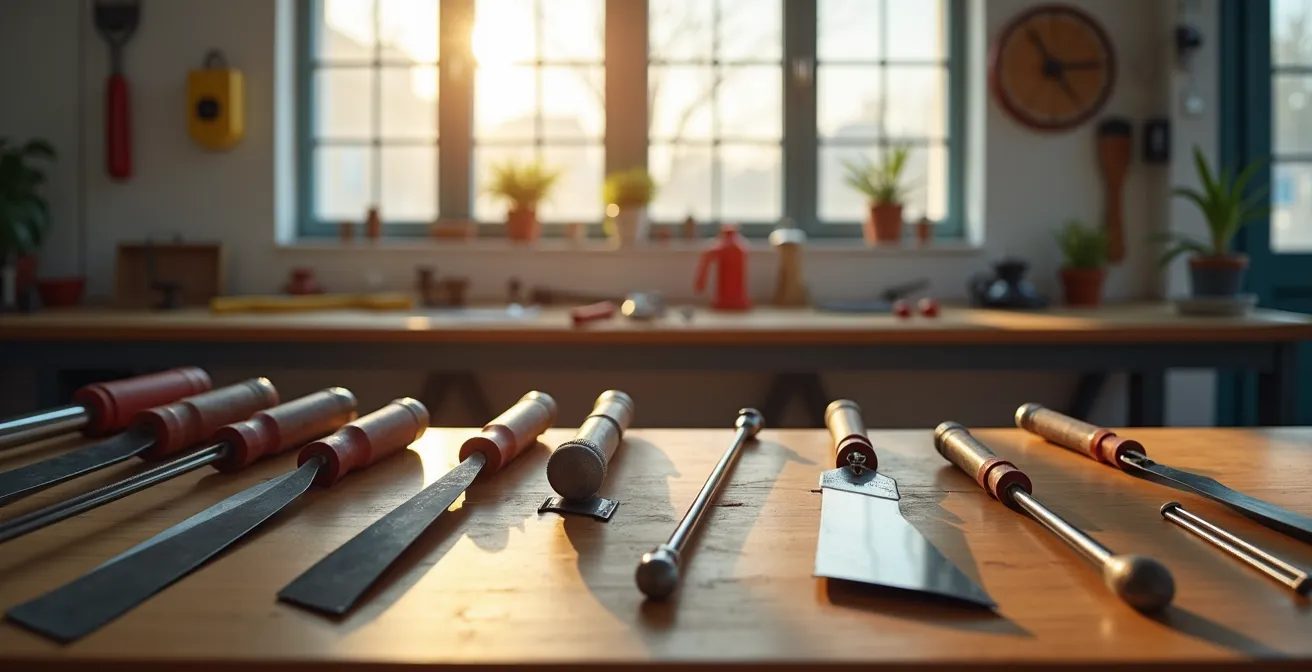
Every roofing contractor knows the frustration of watching a crew lose hours to preventable delays. Tools left at ground level. Measurement errors discovered three rows into installation. Weather interruptions that could have been managed. These aren’t dramatic failures—they’re the silent profit killers that separate efficient operations from those constantly scrambling to maintain margins.
The difference often comes down to strategic supply choices. Not just having equipment, but selecting roofing supplies that target specific workflow bottlenecks. When contractors invest in precision layout tools or proper staging systems, they’re not buying products—they’re purchasing hours back from each project.
From accurate job setup to quality verification, each supply category eliminates a specific workflow bottleneck that costs contractors hours on every project. This approach transforms equipment decisions from reactive purchases into strategic investments that compound efficiency gains across every phase of installation.
Your Roofing Efficiency Toolkit in 7 Categories
Professional roofing contractors maximize profitability by eliminating time-drain bottlenecks through strategic supply selection. This guide covers five critical supply categories organized by workflow phase: precision layout tools that prevent cascade failures, staging equipment that eliminates wasted vertical movement, fastening systems optimized for speed and quality, weather protection that extends working windows, and verification tools that catch problems before callbacks. Each category directly addresses measurable productivity losses that generic equipment lists overlook, with ROI typically realized within 5-7 projects through reduced rework and weather delays.
Layout Supplies That Prevent Hours of Rework
The most expensive mistakes in roofing happen before the first shingle goes down. Measurement errors create cascade failures that compound with every subsequent row, turning a minor miscalculation into hours of tear-out and reinstallation. Yet most contractors treat layout as a phase to rush through rather than the foundation that determines whether everything else proceeds smoothly.
The financial impact is substantial. Measurement errors add 7-15% cost increase to roofing projects, draining margins before installation even begins. This isn’t just about buying better tape measures—it’s about investing in marking systems that maintain accuracy throughout the job duration, even under sun and rain exposure.
High-visibility chalk lines represent the first line of defense. Standard chalk washes away in morning dew or fades under direct sunlight within hours. Professional-grade marking systems use weather-resistant formulations that remain visible for days, allowing crews to maintain reference points without constant re-marking. On complex roof geometries with multiple valleys and hips, these persistent guidelines prevent the gradual drift that creates alignment problems.
Technology has transformed measurement precision for complex geometries. Digital measuring tools eliminate the calculation errors that plague irregular roof shapes, automatically accounting for pitch variations and complex angles. The adoption rate reflects their value: 58% of roofing companies use aerial measurement technology, reducing errors by 15%, with implementation growing as contractors recognize the ROI.

The cascade effect of initial layout mistakes multiplies time loss exponentially. A half-inch error in the first row becomes a three-inch gap by row fifteen, forcing crews to either accept visible misalignment or strip away hours of completed work. Experienced contractors know this pattern: the decision to “work around” a layout error always costs more than stopping to correct it immediately.
Prevention-focused layout supplies pay for themselves on the first job that avoids major rework. A $200 investment in precision marking tools prevents the 4-6 hour tear-out that destroys a project’s labor budget. This is why the most profitable contractors treat layout accuracy as non-negotiable—they’ve calculated what cascade failures actually cost.
Staging Equipment That Eliminates Wasted Trips
Watch any roofing crew for an hour and count the vertical trips. Crew members climbing down for fasteners. Walking the perimeter to retrieve flashing. Descending to ground level for tools left in the truck. Each trip feels minor in isolation, but the cumulative time loss is staggering—contractors lose 15-25% of workday productivity to unnecessary movement.
This isn’t about worker laziness. It’s about staging systems that position materials by workflow progression rather than delivery convenience. Most crews stage materials where the truck can reach, not where the installation sequence demands. The result is constant retrieval trips that break installation rhythm and drain energy on multi-story projects.
Commercial Roofing Technology Adoption
According to Roofing Contractor’s 2024 survey, 83% of commercial contractors have implemented estimating software while 64% use aerial measurement technology, with another 14% planning adoption by 2026. This technology integration has significantly reduced material staging errors and improved project workflow efficiency across the industry.
Adjustable roof brackets and staging platforms create workflow zones rather than just perimeter access points. The strategic approach positions frequently-needed materials—fasteners, underlayment, flashing—within arm’s reach of active work areas. This sounds obvious, yet most staging setups prioritize safety compliance over workflow optimization, meeting code requirements while ignoring productivity gains.
Material lift systems and conveyor solutions deliver supplies to active work areas, transforming the logistics of large projects. On jobs requiring 300+ squares, the difference between ground-level staging and elevated delivery points saves hours daily. Crews maintain installation momentum instead of rotating members off-roof for material retrieval.
The financial case becomes clear through time-motion analysis. On a two-story residential project, each unnecessary trip consumes 3-4 minutes when accounting for ladder navigation and safety protocols. A crew making 15 such trips daily loses an hour of productive installation time. Scale that across a week-long project, and poor staging costs 5-7 hours—nearly a full workday of lost productivity.
The math shifts dramatically on three-story commercial projects where vertical travel time doubles. A 5% margin error on 20 jobs equals thousands in losses when staging inefficiencies compound across multiple projects. Contractors who implement zone-based staging systems typically recover the equipment investment within 3-4 major jobs through pure time savings.
Fastening Systems That Double Your Installation Speed
The conversation around fastening systems usually centers on nail guns as generic tools. Contractors discuss pneumatic versus battery-powered as if these categories tell the complete story. This superficial analysis misses the system optimization that separates fast installation from truly efficient installation—capacity, reload frequency, power source, and fastener-material matching working in concert.
Coil nailers versus strip nailers represents the first strategic decision. Magazine capacity determines reload frequency, which directly impacts rhythm on large-scale projects. A 120-nail coil magazine allows uninterrupted work across significantly more area than a 30-nail strip, reducing the stop-start pattern that breaks crew flow. On 300+ square jobs, this capacity difference compounds into measurable time savings.
The pneumatic versus battery-powered debate requires honest productivity comparison beyond marketing claims. Pneumatic systems deliver consistent power but demand compressor setup, hose management, and maintenance. Battery platforms offer mobility but require rotation planning for charge management and typically sacrifice some driving power. The right choice depends on job parameters—battery systems excel on residential tear-offs with frequent position changes, while pneumatic maintains advantages on large commercial installations with centralized work zones.
Power source selection interacts with fastener strategy in ways contractors often overlook. The most advanced nailer becomes a liability if paired with fasteners that fail quality inspection. Fastener length, gauge, and coating must match specific materials and weather conditions to avoid callbacks that negate any installation speed gains.
Wrong fastener selection creates callbacks that destroy project profitability. Using fasteners with inadequate corrosion protection in coastal environments or selecting incorrect length for specific decking thickness leads to failures that surface months later. The callback for fastener failure doesn’t just cost repair time—it damages reputation and triggers warranty disputes that consume hours of administrative effort.
Strategic fastening system optimization views speed and quality as complementary rather than competing priorities. The fastest installation means nothing if it requires return visits. Contractors who match nailer capacity to project scale, select power sources based on actual workflow patterns, and pair equipment with properly-specified fasteners consistently complete jobs faster while reducing callback rates below industry averages.
Protection Materials That Keep Crews Working Through Weather
Weather delays represent accepted losses in roofing—the industry standard response to forecasted rain or high winds. Yet this reactive approach ignores the distinction between complete shutdown weather and marginal conditions where proper protection extends safe working windows. The difference between a 60% productivity day and a 90% productivity day often comes down to temporary barriers and surface treatments.
Most contractors stock tarps for emergency coverage but don’t strategically deploy weather protection as a productivity tool. This mindset costs partial working days throughout the season. Morning dew, light drizzle, or approaching storms don’t require complete work stoppage—they require proactive protection systems that allow continued progress on sheltered portions of the roof.
Temporary weather barriers and quick-deploy tarp systems extend safe working hours during marginal conditions by 3-4 hours per day. These aren’t the emergency tarps thrown over exposed areas at day’s end. Professional weather management uses structured barrier systems that create protected work zones, allowing installation to continue while monitoring weather progression.
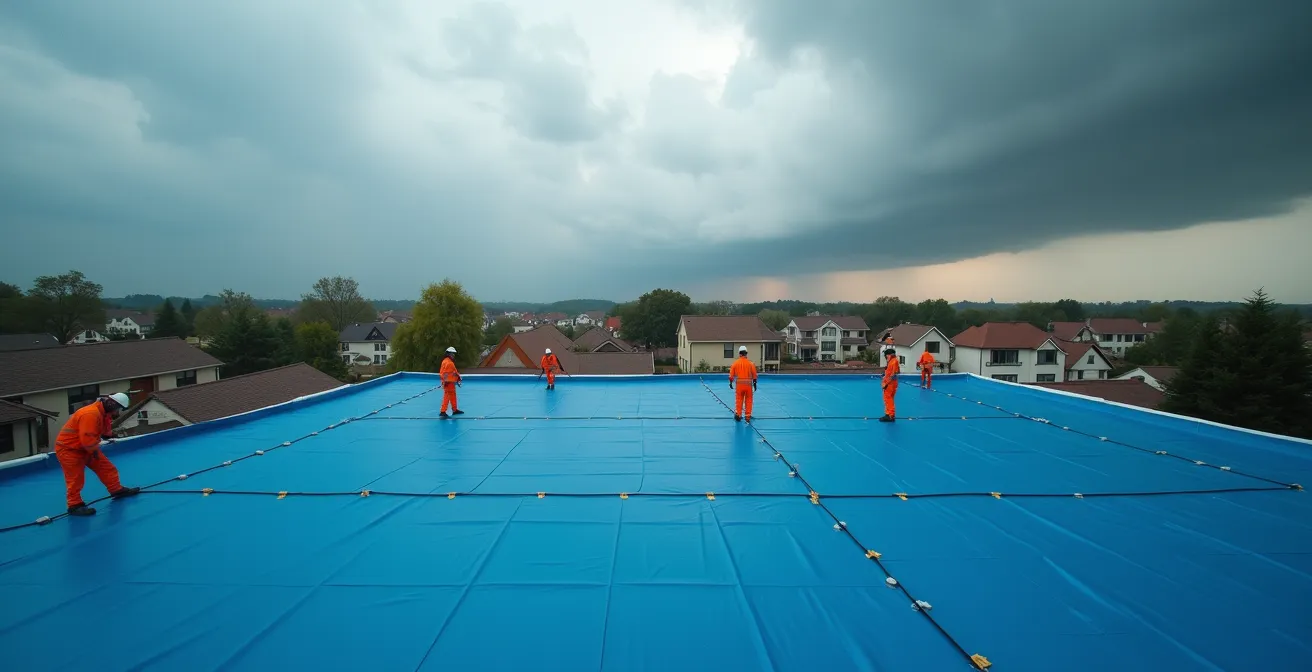
Non-slip surface treatments and walk pads maintain both safety and speed during dew, humidity, or light moisture conditions. The hours between sunrise and mid-morning often feature surface condensation that creates slip hazards without actual precipitation. Crews equipped with temporary traction solutions work through these windows instead of waiting for surfaces to dry naturally, capturing 2-3 hours of productive time.
Strategic partial-protection setups leverage roof geometry and weather direction. When storms approach from the north, south-facing slopes often remain workable for extended periods with minimal protection. Rather than shutting down the entire job, experienced crews continue installation on sheltered areas while monitoring conditions, sometimes maintaining 60-70% productivity during weather events that would otherwise halt all work.
The ROI calculation is straightforward. Weather protection equipment typically costs $500-1200 for a comprehensive system. Converting three partial-shutdown days per season from 60% to 90% productivity recovers 2-3 full workdays annually. On projects with tight schedules and weather-dependent completion bonuses, this equipment often pays for itself on a single job.
Weather supplies shift from reactive emergency tools to proactive schedule protection when contractors recognize that marginal conditions represent opportunity rather than automatic delay. The crews that work safely through morning dew and light drizzle complete projects faster while competitors wait for perfect conditions that rarely arrive on schedule.
Verification Tools That Catch Problems Before Callbacks
Quality verification rarely appears on roofing supply lists because it doesn’t directly accelerate installation. This omission reveals a fundamental misunderstanding of project economics. A callback for trapped moisture or improper ventilation doesn’t just cost the 8-12 hours of tear-out and reinstallation—it destroys the profit from 2-3 additional jobs through warranty work that generates zero revenue.
Most contractors treat quality as a byproduct of skilled workmanship rather than a supply-enabled process with objective verification points. This works until it doesn’t. The experienced installer who’s never had a moisture callback becomes the cautionary tale after trapped condensation creates a catastrophic failure that requires complete roof replacement under warranty.
Moisture meters and thermal imaging cameras identify substrate problems before installation, preventing callbacks from issues that skilled craftsmanship cannot overcome. A roof deck with 18% moisture content will fail regardless of installation quality. Detecting this during initial inspection costs 15 minutes. Discovering it when the homeowner reports interior water damage nine months later costs everything.
These diagnostic tools reveal problems invisible to visual inspection. Thermal imaging identifies ventilation inadequacies, insulation gaps, and areas where heat loss indicates future condensation risk. Addressing these issues before installation prevents the warranty claims that devastate annual profitability, yet many contractors skip this verification step to save the upfront time investment.
Pitch gauges and precision level systems verify proper water flow paths before problems manifest as leaks. Experienced installers develop reliable intuition for proper drainage, but complex roof geometries with multiple valleys create scenarios where visual assessment misleads. A 1/4-inch pitch variation that seems acceptable during installation becomes a standing water problem during the first sustained rainfall.
Documentation supplies provide both quality proof and liability protection. Photo documentation of substrate condition, measurement logs showing proper fastener spacing, and verification records of moisture readings create objective evidence that protects against warranty disputes. When a homeowner claims improper installation caused a leak, contemporaneous documentation resolves disputes in minutes rather than hours of investigation.
The highest-ROI time investment in roofing isn’t faster installation—it’s the 20-30 minutes spent verifying conditions before work begins and documenting quality throughout the process. This verification prevents the catastrophic callbacks that can eliminate profit from an entire month of successful projects. Contractors who implement systematic verification protocols consistently maintain callback rates below 2% while industry averages hover around 8-12%.
Prevention supplies deliver returns that dwarf installation speed gains. A $400 moisture meter prevents a $6,000 warranty callback. A $150 pitch gauge catches the drainage issue that would generate three service calls and a negative review. The contractors who understand this math treat verification tools as essential supplies rather than optional quality-assurance luxuries.
Key Takeaways
- Layout precision prevents cascade failures that compound into hours of rework with each subsequent row
- Strategic staging by workflow zones eliminates 15-25% of wasted time from unnecessary vertical trips
- Weather protection systems extend working windows by 3-4 hours during marginal conditions
- Verification tools provide the highest ROI by preventing callbacks that eliminate profit from multiple successful jobs
- Systematic supply selection targeting workflow bottlenecks delivers compounding efficiency gains across all project phases
Building a Time-Efficient Supply Strategy
The progression from layout through verification isn’t arbitrary—it maps to the workflow phases where time losses accumulate. Contractors who invest in precision marking establish the foundation. Those who add strategic staging maintain installation momentum. Weather protection preserves that momentum through marginal conditions. Verification ensures that speed never compromises quality.
This systematic approach differs fundamentally from generic equipment lists that treat all supplies as equivalent purchases. Not every tool delivers equal ROI. A $200 investment in layout precision that prevents a 6-hour rework event returns 30:1 on a single project. Understanding which bottlenecks cost the most time allows strategic investment that compounds returns across every subsequent job.
The competitive advantage comes from recognizing that time-saving supplies aren’t luxuries for large commercial contractors—they’re essential profit protection for operations of any size. The two-person residential crew loses the same percentage of productivity to poor staging as the ten-person commercial team. The difference is that smaller operations often can’t absorb these losses without dropping below sustainable margins.
Implementing these supply categories requires initial capital outlay, but the payback period rarely exceeds 5-7 projects. Contractors can explore options for sustainable construction site solutions that enhance both efficiency and environmental responsibility. For those seeking specialized components, many can explore customized metal parts designed for specific workflow optimization needs.
The roofing contractors who consistently underbid competitors while maintaining better margins aren’t cutting corners—they’ve eliminated the time-drain bottlenecks that force others to pad estimates with contingency hours. Their competitive advantage isn’t cheaper labor or lower material costs. It’s systematic investment in supplies that purchase hours back from every project.
Frequently Asked Questions About Roofing Supplies
How do partial protection setups help during approaching storms?
Strategic partial-protection allows crews to continue working on sheltered slopes while weather approaches, maintaining 60-90% productivity instead of complete shutdown. By monitoring weather direction and protecting exposed areas, experienced contractors capture several additional working hours that competitors lose to precautionary shutdowns.
What’s the ROI on weather protection equipment?
Converting partial productivity days (60%) into near-full days (90%) typically pays for protection equipment within 5-7 jobs through reduced weather delays. On projects with completion bonuses or tight schedules, the ROI can be realized on a single job when weather protection prevents costly schedule extensions.
Why do measurement errors create cascade failures?
Initial layout mistakes compound with each subsequent row because each new course builds on the alignment of previous work. A half-inch error in the first row becomes several inches of misalignment by row fifteen, forcing crews to either accept visible defects or tear out hours of completed installation to correct the problem.
How do verification tools prevent callbacks?
Moisture meters, thermal cameras, and pitch gauges identify substrate problems before installation that skilled workmanship cannot overcome. Detecting issues like trapped moisture, inadequate ventilation, or improper drainage during initial inspection prevents warranty callbacks that can cost 8-12 hours of unpaid remediation work and damage contractor reputation.