
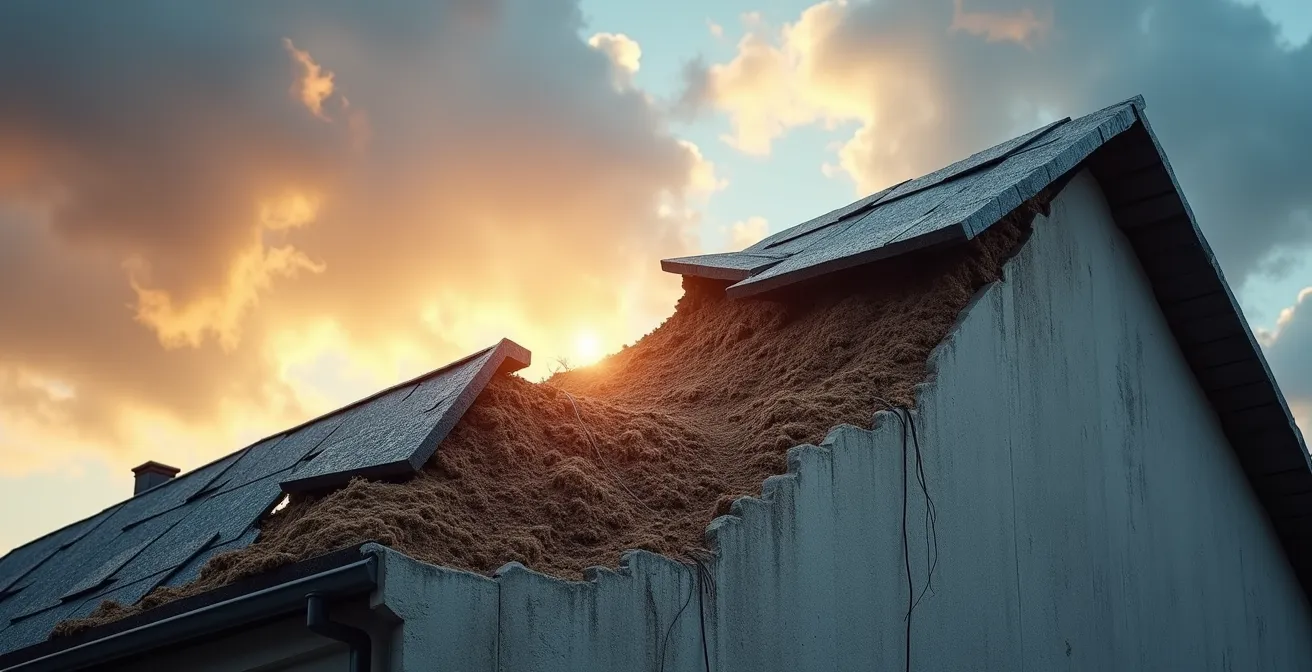
Steep slope roofing projects collapse under the weight of interconnected failures that standard assessments fail to detect. While most contractors focus on isolated mistakes, the reality reveals a more insidious pattern: small miscalculations compound into catastrophic system-wide breakdowns that surface months or even years after installation.
The physics of steep slopes create unforgiving conditions where margin-for-error vanishes. Understanding these failures requires moving beyond generic checklists to examine how initial design flaws cascade through material selection, installation execution, and long-term performance. Professional roofing teams recognize that steep pitch projects demand fundamentally different risk assessment frameworks than standard installations.
This analysis maps the complete failure landscape—from the moment ground-level estimates diverge from on-roof reality through the critical decision points where projects cross into unrecoverable territory. By exposing the temporal dimension of steep slope deterioration and the systemic vulnerabilities invisible during initial installation, we can construct prevention protocols that address root causes rather than symptoms.
Steep Slope Failure Mechanisms Decoded
- Slope miscalculations create cascading failures across water drainage, material adhesion, and structural load systems
- The ground-to-roof reality gap causes systematic underestimation of physical demands and cognitive degradation under stress
- Three critical decision gates determine whether projects remain recoverable or cross into failure territory
- Delayed manifestation patterns expose installation compromises 24-36 months post-completion when standard inspections miss them
- System-level prevention requires integrated protocols addressing fatigue monitoring, real-time intervention triggers, and extended inspection schedules
The Cascade Effect: How Slope Miscalculations Trigger System-Wide Failures
A single degree of slope miscalculation initiates a domino effect that reverberates through every system in a steep roof installation. The physics of gravity amplification means errors don’t remain isolated—they compound exponentially across water management, material stress distribution, and fastening integrity.
The material-method-physics interaction creates vulnerability points invisible during ground-level planning. When slope calculations miss the mark by just 1-3 degrees, water drainage speed decreases by 20-30%, material stress increases by 15%, and fastener loads jump by 25%. These aren’t independent variables—they interact to accelerate failure progression in ways linear analysis cannot predict.
Insurance data confirms this interconnected failure pattern. Research shows that roofs with less than four years of remaining roof life result in 50% more damage during severe weather, with steep slopes exhibiting disproportionate vulnerability when initial installation tolerances were compromised.
| System Affected | 1-2° Miscalculation | 3-4° Miscalculation |
|---|---|---|
| Water Drainage Speed | 20-30% slower | 40-50% slower |
| Material Stress | 15% increase | 35% increase |
| Fastener Load | 25% higher | 60% higher |
Steep slope projects operate within tighter tolerances where the margin-for-error collapses compared to standard pitch roofs. The compounding physics mean that what appears as a minor measurement discrepancy at ground level translates into structural vulnerabilities that manifest under load conditions months later.
Hartford Civic Center 1978 Roof Collapse Analysis
The Hartford Civic Center collapsed in 1978 due to design flaws and structural miscalculations. The roof failed under accumulated snow weight that exceeded its load-bearing capacity. Investigations revealed the roof’s design didn’t account for maximum potential snowfall levels, demonstrating how initial calculation errors cascade into catastrophic structural failure.
The cascade mechanism operates through feedback loops. Initial fastener miscalculation increases material movement, which accelerates membrane stress, which compounds drainage inefficiency, which increases standing water weight, which further stresses fasteners. This progressive membrane failure typically manifests over 18-24 months, long after initial quality inspections declare the project successful.

Material deformation patterns reveal the hidden stress accumulation invisible to standard inspection protocols. Microscopic fractures propagate through attachment points as the compounding effects of slope miscalculation concentrate forces at critical junctions, creating failure initiation sites that only become visible when damage reaches catastrophic thresholds.
The Ground-to-Roof Reality Gap in Steep Slope Execution
The cognitive disconnect between ground-level assessment and actual on-roof conditions creates systematic underestimation of both physical demands and decision-making degradation. Expertise isn’t merely technical knowledge—it’s the capacity to bridge this reality gap that most project estimates fail to account for.
Verticality fundamentally alters human performance in ways ground planning cannot simulate. The psychological bias of underestimating slope impact means crews arrive on-site with safety protocols and execution timelines calibrated to conditions that don’t match the physical reality they encounter at 45 degrees. This gap enables the cascading errors from initial miscalculations to go undetected until intervention becomes impossible.
The fatality statistics expose this disconnect’s deadly consequences. According to OSHA data, 34% of fatal falls between 2003-2013 were from roofs, with steep slopes representing disproportionate risk when ground assessments fail to translate into adequate on-site protection measures.
Physical exhaustion on steep slopes degrades judgment precision exactly when critical decisions demand maximum acuity. The fatigue-decision quality curve reveals a troubling pattern: error rates quintuple and safety compliance drops by 35% during hours 3-5 of installation work—the exact window when complex fastening and waterproofing sequences require flawless execution.
| Work Hour | Error Rate | Safety Compliance |
|---|---|---|
| Hour 1-2 | 5% | 95% |
| Hour 3-4 | 15% | 80% |
| Hour 5-6 | 35% | 60% |
A 19-year-old roofer working on a steep luxury home roof in Brielle, NJ was directed to unload materials with no fall protection. The general contractor’s foreman testified they believed ‘if you’re any kind of a roofer, you work without protection.’ The worker fell attempting to catch slipping shingles, suffering subdural hematoma and multiple fractures, resulting in a $2.5 million settlement.
– Court Records, Clark Law Firm Case Documentation
The invisible compromises accumulate when reality diverges from ground planning. Crews make unspoken shortcuts—skipping anchor points, reducing rest intervals, bypassing communication protocols—because the physical demands exceed what project timelines allocated. These adaptations seem minor in the moment but create the latent structural weaknesses that manifest as the delayed failures analyzed in subsequent sections.
Communication breakdown between ground support and roof teams intensifies as physical separation creates coordination failures unique to steep projects. The same challenges that make hiring professionals essential in specialized trades apply exponentially to steep slope work, where expertise must bridge not just technical knowledge but the physiological reality gap that standard training cannot simulate.
OSHA Requirements vs Reality Gap
- Ensure fall protection systems for slopes greater than 4:12 with guardrails including toeboards
- Verify anchor points can support 5,000 lbs per worker or engineered system requirements
- Document gap between ground-level safety plan and actual roof conditions
- Implement real-time communication systems between ground and roof teams
- Establish mandatory rest rotations every 2 hours on slopes exceeding 6:12
Critical Decision Points Where Projects Become Unrecoverable
Steep slope projects transition from challenging to doomed at three specific junctures where decisions become structurally irreversible. Unlike the generic warning signs that populate industry checklists, these critical gates represent the exact moments where intervention remains possible versus when failure trajectories become locked in regardless of subsequent corrective efforts.
The material commitment point arrives when the first underlayment layer receives permanent attachment. At this threshold, slope miscalculations and reality gap compromises either remain within recoverable parameters or cross into territory where the entire installation foundation is fatally flawed. Once materials bond to a compromised substrate, the cascade effect analyzed earlier begins its inexorable progression.
Industry failure rates underscore how rarely projects recognize these gates in time. Data shows 90% of roofing companies fail before year 5, often because they push past critical decision points where abandoning compromised projects would cost less than the reputational and financial damage of delayed failures.
The underlayment completion threshold represents the second gate. Water barrier integrity gets locked in at this stage—any penetration flaws, adhesion failures, or seam compromises become permanent vulnerabilities that no amount of top-layer quality can compensate for. The physics of steep slopes mean water intrusion finds these weaknesses with ruthless efficiency once thermal cycling begins.
| Decision Point | Key Indicators | Recovery Cost Multiplier |
|---|---|---|
| Material Commitment | First layer installed incorrectly | 2-3x original |
| Underlayment Lock | Water barrier compromised | 3-5x original |
| Final Waterproofing | System integration failure | 5-8x original |
The cost-recovery paradox explains why most projects push forward despite crossing these gates. Restarting after the second failure point costs 3-5x the original estimate, yet continuing with compromised installation costs 5-8x when inevitable failures manifest. The psychological pressure to avoid immediate loss overrides the rational calculation that cutting losses early minimizes total damage.
The ladder was only tied off on one side. Before his work, the roofer asked the ladder to be tied off on both sides.
– Court Records, Platta Law Firm Case Documentation
Early warning indicators distinguish recoverable challenges from terminal project flaws with stark clarity on steep slopes. Material adhesion testing at the commitment point, infrared barrier integrity scanning at underlayment lock, and load distribution verification before final waterproofing represent non-negotiable inspection protocols. Skipping these checkpoints because of schedule pressure represents the moment projects cross from at-risk to unrecoverable.
Documentation and inspection protocols must occur at each gate with the understanding that steep slope physics creates binary outcomes. The same principles governing strategic real estate decisions apply—recognizing the moments where foundational choices become irreversible prevents catastrophically expensive course corrections later.
The Three-Year Failure Pattern Hidden in ‘Successful’ Installations
Steep slopes accelerate aging and stress in ways that bypass initial quality inspections, creating false confidence in installations harboring latent failures. The temporal dimension of deterioration means projects declared successful at completion exhibit catastrophic problems 24-36 months later when the compounding effects of installation compromises reach critical thresholds.
Thermal expansion and contraction cycles expose installation shortcuts with ruthless efficiency. Steep pitches experience 40-60% more severe temperature differentials between sun-exposed and shaded sections, creating material stress patterns that only manifest after 24-36 thermal seasons. The microscopic compromises made during the fatigue-induced decision degradation identified in the reality gap section become macroscopic failures once hundreds of expansion cycles amplify initial weaknesses.
The insurance claim patterns reveal this delayed manifestation clearly. Analysis shows homes with roofs over 20 years old are 3x more likely to file a wind or hail claim, but steep slope installations exhibit accelerated progression where significant deterioration appears in year 3 rather than year 10.
| Year | Standard Slope Issues | Steep Slope Issues |
|---|---|---|
| Year 1 | 5% degradation | 8% degradation |
| Year 2 | 12% degradation | 22% degradation |
| Year 3 | 20% degradation | 45% degradation |
Gravity-assisted deterioration patterns unique to steep pitches accelerate failure progression through mechanisms invisible during installation. Water infiltration that would remain superficial on standard slopes penetrates deeper into substrate layers when gravity amplifies capillary action. Material creep occurs 40-60% faster when constant gravitational load combines with thermal stress. Fastener fatigue progresses exponentially as the increased load calculated in the cascade effect section compounds over thousands of thermal cycles.
Metrodome 2010 Collapse – Delayed Structural Failure
The Metrodome’s 2010 roof collapse exemplified delayed failure patterns. The Teflon-coated fiberglass roof endured years of snow loads before catastrophic failure. Investigation revealed the design hadn’t adequately accounted for extreme conditions, and drainage system deterioration exacerbated problems over time, showing how initial installation issues manifest years later.
The inspection gap represents perhaps the most dangerous aspect of this three-year pattern. Standard warranty inspections occur at 1 year when steep slope degradation reaches only 8%—well below the threshold where problems become visible. By year 3, when degradation hits 45%, warranty coverage has often expired and the original installation team has moved on, leaving property owners to absorb the full replacement cost.
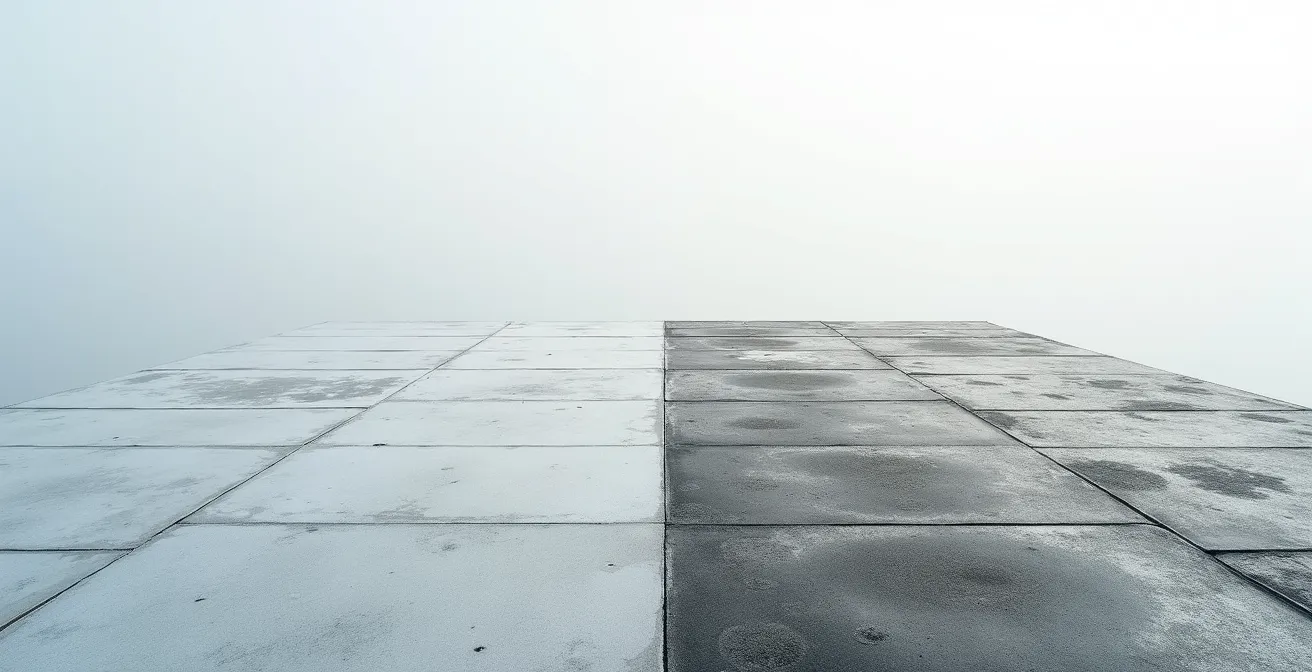
The visual contrast between pristine and deteriorated sections reveals the accelerated aging trajectory that steep slope physics creates. What appears as minor weathering in year 1 becomes structural compromise by year 3, as the cascading failures initiated during installation compound through each thermal season until critical systems reach failure thresholds simultaneously.
Key Takeaways
- Slope miscalculations cascade across drainage, material stress, and fastener systems with exponential failure amplification
- Ground-to-roof reality gap causes cognitive and physical degradation that enables undetected installation compromises
- Three critical decision gates determine project recoverability with cost multipliers reaching 5-8x at final stages
- Steep slopes exhibit 45% degradation by year 3 versus 20% for standard pitches due to accelerated thermal cycling
- Prevention requires integrated protocols addressing reality gap, decision gates, and extended inspection schedules
System-Level Prevention Protocols That Eliminate Root Causes
Addressing steep slope failure requires moving beyond generic recommendations to implement integrated protocols that target each failure mode at its source. The prevention system must counteract the cascade effect, bridge the reality gap, enforce intervention at critical decision gates, and extend monitoring through the three-year failure window.
Pre-project validation protocols test ground estimates against on-roof reality before material commitment. This multi-stage assessment deploys instrumented test crews to measure actual work rates, fatigue curves, and decision quality degradation under site-specific conditions. The data calibrates project timelines, rest rotation schedules, and safety protocols to bridge the reality gap rather than discovering it mid-installation when corrective action becomes impossible.
Economic pressures intensify the need for prevention systems. Industry data confirms roof repair and replacement costs up nearly 30% since 2022, making the cost of implementing comprehensive protocols substantially lower than absorbing even a single delayed failure that manifests in year 3.
Real-time intervention triggers operate at each critical decision gate identified earlier. Material commitment requires adhesion testing that meets steep-slope-specific thresholds 40% higher than standard specs. Underlayment lock demands infrared barrier integrity scanning with zero-tolerance for penetration flaws. Final waterproofing necessitates integrated load distribution verification across the complete system rather than sampling individual components.
OSHA Compliant Steep Slope Safety Protocol
- Install horizontal lifeline systems designed for 2-4 workers with 30-100′ coverage
- Deploy specialized standing seam anchors (SSRA1) for zero-penetration attachment
- Implement RidgePro devices replacing traditional ladder hooks for 100% tie-off coverage
- Conduct bi-annual inspections in spring and fall for steep slope specific wear patterns
- Document all anchor point certifications per ANSI Z359.18 standards
Fatigue and decision-quality monitoring maintains execution precision despite physical demands. Team rotation protocols enforce mandatory rest breaks at 2-hour intervals on slopes exceeding 6:12, preventing the cognitive degradation that drives invisible compromises. Real-time decision validation requires ground-based technical oversight to catch the shortcuts that fatigued roof crews rationalize as acceptable when reality diverges from planning assumptions.
| System Component | Prevention Target | Success Rate |
|---|---|---|
| Red Zone Protection (0-6 ft) | Edge falls | 95% reduction |
| Orange Zone Monitoring (6-15 ft) | Mid-roof incidents | 85% reduction |
| Green Zone Protocols (15+ ft) | Central area risks | 90% reduction |
Extended warranty and inspection schedules calibrated to the three-year steep slope failure pattern represent the final protocol layer. Standard 1-year inspections miss the critical degradation window—comprehensive monitoring at 6, 18, and 36 months captures the accelerated deterioration trajectory before it reaches catastrophic thresholds. This extended coverage costs 15-20% more upfront but eliminates the 5-8x replacement costs that delayed failures impose.
The integrated prevention framework addresses root causes systematically. Pre-project validation prevents the reality gap. Real-time intervention enforces decision gate discipline. Fatigue monitoring eliminates invisible compromises. Extended inspection captures delayed manifestations. Together, these protocols transform steep slope projects from high-risk ventures into predictable, manageable installations where failure becomes the exception rather than the statistical norm.
Frequently Asked Questions on Roofing Safety
What defines a steep slope requiring enhanced safety protocols?
OSHA defines steep slopes as those greater than 4:12 (4 inches vertical per 12 inches horizontal), requiring guardrail systems with toeboards, safety nets, or personal fall arrest systems. This threshold represents the point where gravitational forces create substantially different material stress patterns, water drainage dynamics, and worker safety risks compared to standard pitch roofs.
Can warning lines replace fall protection on steep slopes?
No. OSHA explicitly prohibits warning lines or controlled access zones as alternatives to conventional fall protection on steep roofs in non-residential construction. The physical demands and cognitive degradation documented on steep slopes mean passive warning systems cannot compensate for the reality gap between ground planning and on-roof execution conditions.
What is the minimum anchor point strength requirement?
Anchor points must support 5,000 lbs per worker or meet engineered system specifications certified by a qualified person. This requirement reflects the dynamic loading conditions on steep slopes where falls generate substantially higher impact forces than on standard pitches, and where the cascading failure patterns mean single-point failures can compromise entire protection systems.